New article
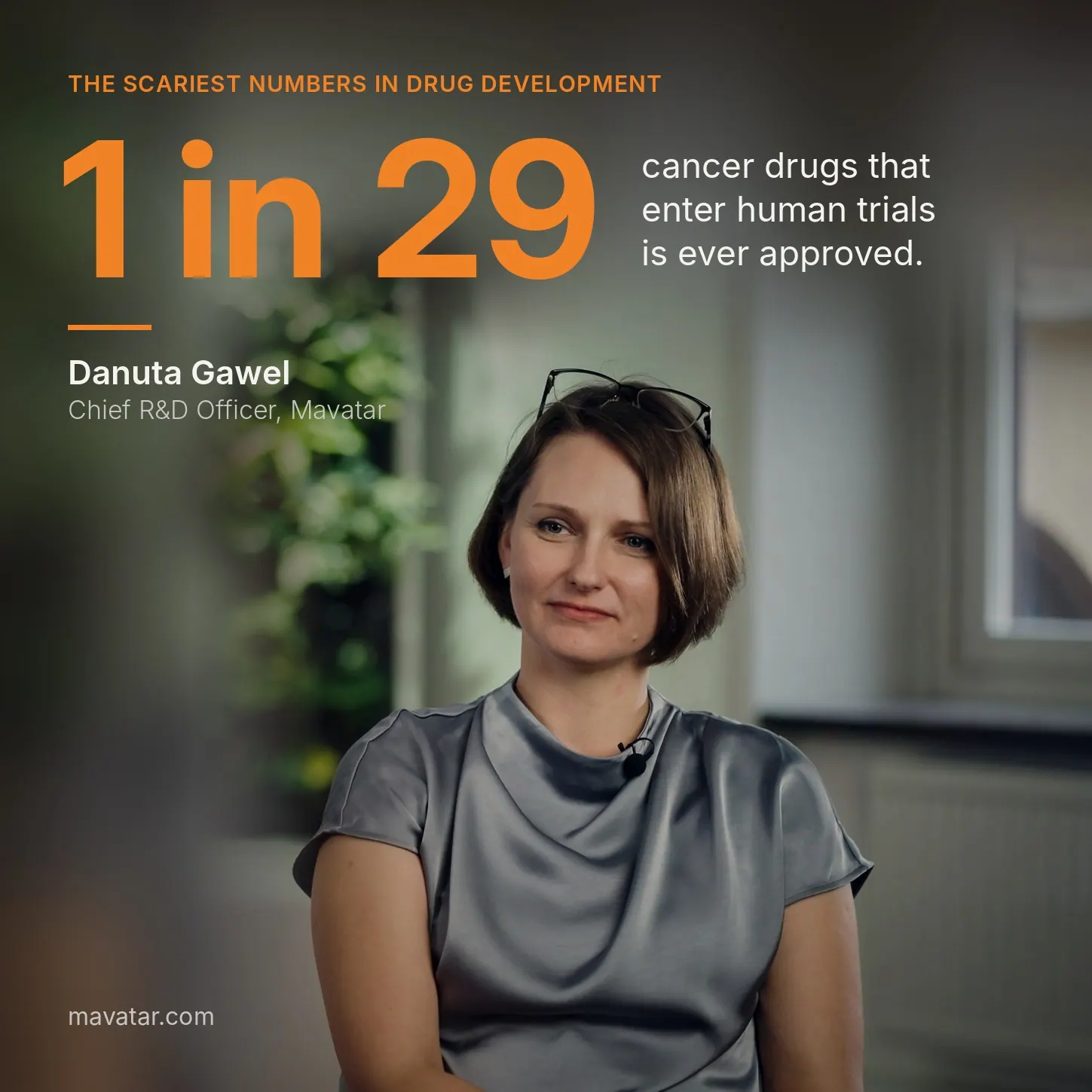
The evidence is already there: an interview with Danuta Gawel
Why computational biology has become a risk-reduction tool in pharma R&D, and why most programs still aren’t set up to use it.

We turn millions of human transcriptomic profiles into clear answers about the biology behind your disease, your drug or your patient.
Our scientists answer your disease-biology questions, from target discovery into the clinic.
Explore disease networks built from millions of public gene-expression profiles. No code needed.
Supports clinicians in choosing the treatment most likely to work for each patient.
Latest news
New article
Why computational biology has become a risk-reduction tool in pharma R&D, and why most programs still aren’t set up to use it.


What we do
The same disease is driven by different biology in different patients. Mavatar maps that biology from millions of human tissue and cell samples. Drug developers use it to choose targets with more confidence, researchers to find what the literature hasn't, and clinicians to understand which treatments are most likely to work. Read more about our publications and validations.
Mavatar Discovery changes how we approach the early stages of a research question. Instead of relying solely on what we can generate in our own cohort, we can immediately explore how our findings relate to the broader biological landscape - across diseases, tissues and datasets.
How it works
Every Mavatar disease model is built the same way, from data found in the public domain, and every result can be traced to its original source.
We collect public gene-expression data from thousands of studies. Every sample is annotated by tissue, disease and technology, then quality-checked and normalized.
DINA, our network framework, combines hundreds of independent datasets for each disease or tissue. Two genes are linked only when they are consistently co-expressed across those datasets. The network shows relationships that hold up across studies, not single experiments or assumptions from the literature. Our breast cancer network, for example, draws on 598 datasets and over 36,000 samples.
Every connection in the network points to the datasets and samples behind it, so scientists can cross-validate any finding. One model then supports many questions, such as disease mechanisms, biomarkers, patient stratification and drug prioritization. It is updated as new data is published.
Evidence
Researchers and pharma R&D leaders use our disease models to explore mechanisms, prioritize targets and put their own data in a wider biological context.
Trusted by
Partners: Pfizer, Takeda Pharma, Örebro Universitet, and Lunds Universitet delivering data-driven resources to identify molecular subtypes of IBD, explore predictors of treatment response, and more.
Through advanced analytics of public transcriptomic data, we aim to contribute to a clearer understanding of IFNγ-driven mechanisms across relevant biological contexts.
A research collaboration with Bruno Paiva, one of Europe's most cited researchers in hematological neoplasms to validate candidate biomarkers and explore biological relationships in AML.
Together with Prof. Tomas Deierborg’s group, we explored galectin-3 and microglial activation in Alzheimer’s disease through brain and disease-specific networks.
Latest news

Whether you’re exploring disease biology, de-risking a drug program or following our clinical work, we’d like to hear what you’re working on.