
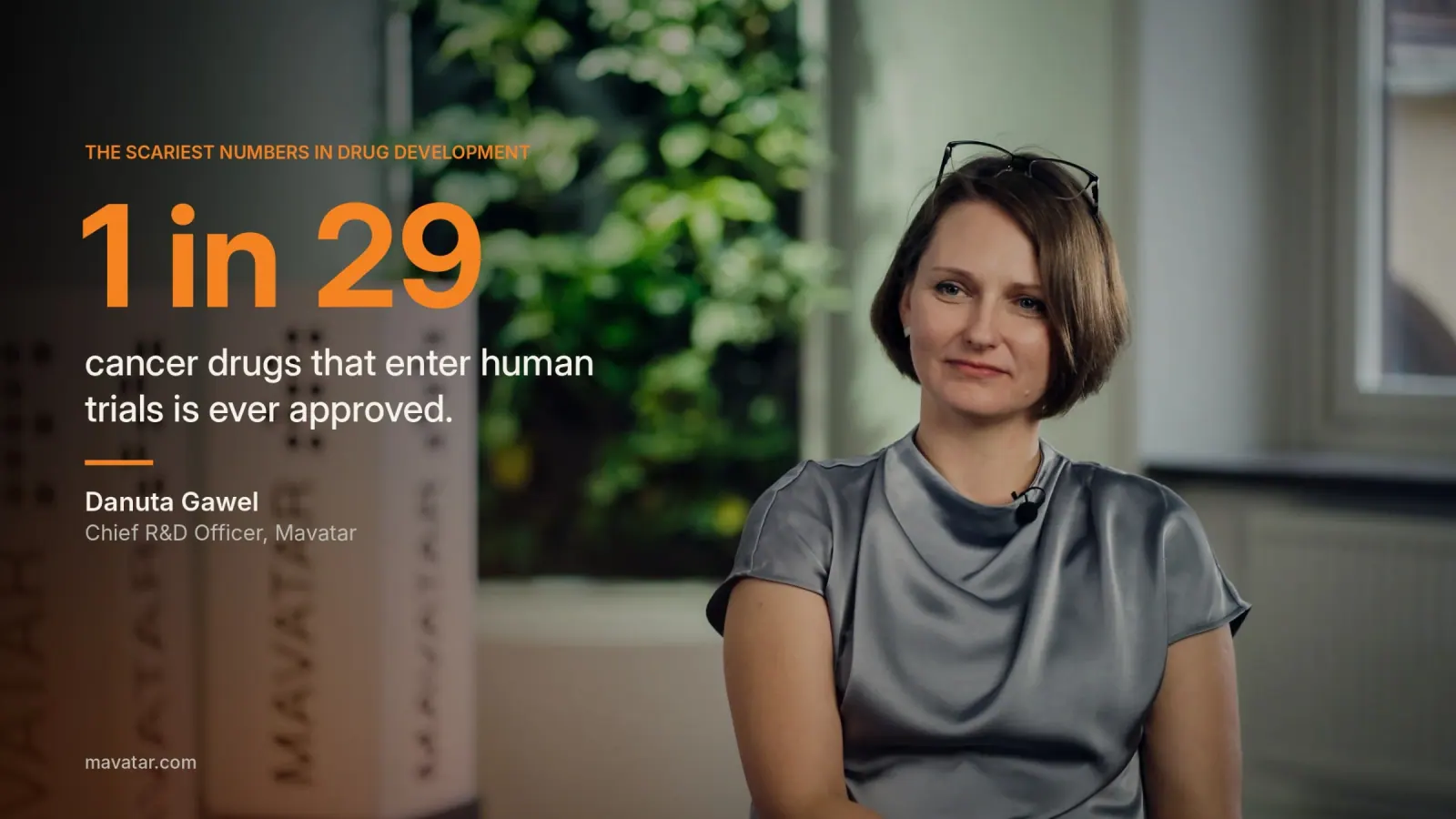
Mavatar, already working with Sobi and other pharma companies, opens its biological intelligence to more drug developers. Built to show which programs are worth pursuing, and which are not. Only one in 29 cancer drugs that enter human trials is ever approved. Mavatar, the biological intelligence behind better-informed decisions, now puts its proprietary DINA technology to work directly on pharma and biotech drug programs. DINA turns large-scale biomedical data into digital disease models that show the biology behind a program, with every answer traceable to its source. The goal is blunt: find out earlier whether a program deserves the next hundred million.
“If your data has never told you to stop, you’re not really asking it anything,” says Danuta Gawel, Chief Research and Development Officer at Mavatar. “Negative evidence has value. Sometimes the best outcome is deciding early not to spend years pursuing the wrong hypothesis.”
Already working with pharma Mavatar is in an ongoing research collaboration with Sobi, exploring IFN-gamma-associated biological pathways in rare subtypes of sepsis. In a Vinnova-funded IBD project with partners including Pfizer and Takeda, Mavatar built the project’s IBD data resource.
”Understanding the underlying biology of rare and immune-mediated conditions is essential for advancing research in the field. Through this collaboration, we aim to further strengthen our scientific knowledge base using structured, data-driven analyses,” says Emmanuel Monet, Head Medical Science Strategy, Sobi
The numbers behind the bet Across all diseases, about one in seven drug candidates entering Phase 1 is approved (Wong, Siah and Lo, Biostatistics, 2019). A Perspective in Nature Reviews Drug Discovery from August 2026 (Bender et al.) finds that reducing failure in Phase 2 does more to lower the cost of a new drug than comparable gains anywhere else in the pipeline. It also notes that evidence of AI’s clinical impact in drug discovery is so far limited.
“The industry has heard a lot of AI promises,” says Gawel. “We would rather show exactly where every answer comes from. If a result can’t be traced back to real patient data, it shouldn’t drive a decision worth years of work.”
How it works DINA (Deep Integrated Network Analysis) is built on more than 20 years of research and 5,884 datasets, and 373,781 samples including single cell/pseudo bulk samples. Its digital disease models are systems-level maps of how genes and biological processes behave in a disease. Through Pharma Partnerships, a partner brings a target or indication, DINA runs the analysis, and Mavatar’s scientists help turn the results into decisions. No black box.
“The earlier you ask who is likely to benefit, the more room you have to collect the right data and reduce uncertainty before a program becomes too expensive to change,” says Gawel.
A Mavatar Science & Halloween Soirée on November 4 Days after Halloween, Mavatar presents the approach on Wednesday 4 November at its Swedish office, followed by a panel on the scariest numbers in drug development with Christina Kaiser, Senior Principal Scientist of Sobi, Ann-Sofie Backman, Associate Professor at Karolinska Institutet and Senior Consultant at Ersta Hospital, who led the Vinnova IBD project, and Stefan Norin, Chief Medical Officer at Oncopeptides.