
To treat disease better, we first need to understand it better
The science behind every answer we give you: a disease model that grows as the world’s biological data repositories grow.

Why it matters
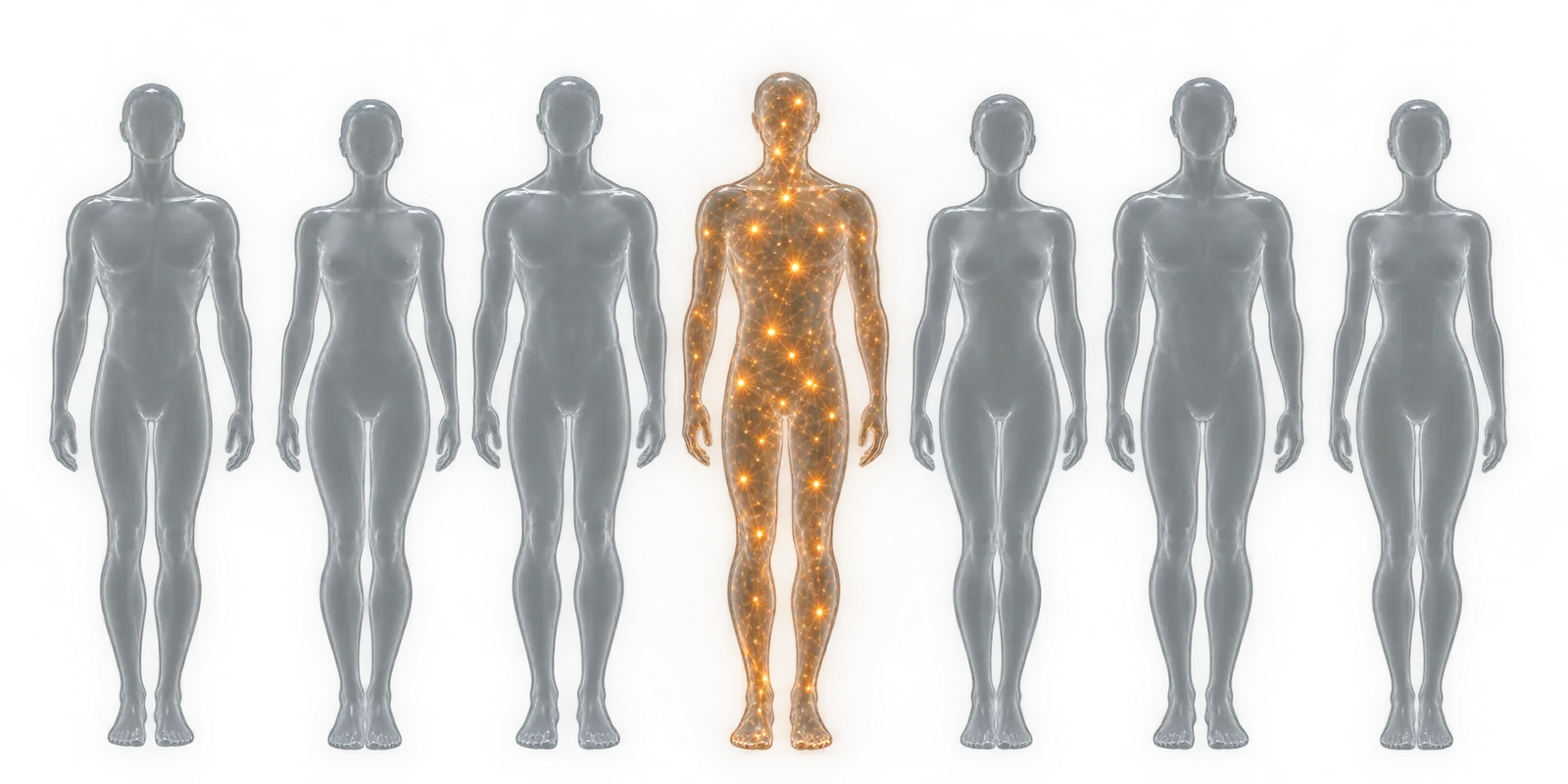
Patients differ, most research assumes they don’t
Patients with the same diagnosis can be in very different molecular states, yet most research and development is still designed around an average patient who doesn’t exist. Those differences are measurable in human data, which means they can inform decisions before a program commits, instead of surfacing later as failed trials or patients who don’t respond.
- Same diagnosis, different biology
- Designed for the average
- Measurable in human data
DINA
Finding order in biological complexity
DINA (Deep Integrated Network Analysis) is built on more than 20 years of research and runs on a foundation of over 8 million public transcriptomes. It turns fragmented molecular data into context-specific models of human disease.
Gene expression across tissues, diseases, cohorts, cell types and experimental settings.
Quality control, biological annotation, network inference and statistical and machine learning state-of-the-art methods.
Networks, functional modules, target neighborhoods and context-specific biological signatures.
The Data
Built on public, peer-reviewed human data
Public repositories such as GEO, ArrayExpress, TCGA, CELLxGENE and the Single Cell Portal hold millions of samples, and more are added every day. For many biological questions the limit isn’t a lack of data but how to use what already exists. Our R&D team curates the metadata for every dataset and sample, including tissue, biopsy site, disease and technology, so data from different studies can be compared fairly.
Public data is transparent, so anyone can inspect the original studies, and it keeps growing as the field publishes. Learning from human patient tissue reduces reliance on animal models alone, and reusing existing data lets lab work focus on validation.
In partner projects, proprietary data can be analyzed alongside public data.
How it works
Learning a disease from many independent studies
DINA looks for the gene relationships that keep appearing across independent experiments, despite the differences between studies. The approach is data-driven, reproducible, and traceable.
We collect bulk and single-cell transcriptomic data from public repositories such as GEO, ArrayExpress and TCGA. Our R&D team curates the metadata for every dataset and sample, including tissue, biopsy site, disease and technology, so each sample is assigned to the right biological context.
Each dataset is checked for quality. The data is then normalized so measurements from different labs, platforms and technologies can be compared fairly.
Datasets that share the same tissue or disease context are combined into one resource. Instead of relying on a single study, DINA brings together thousands of samples from many independent studies, each with its own sources of noise.
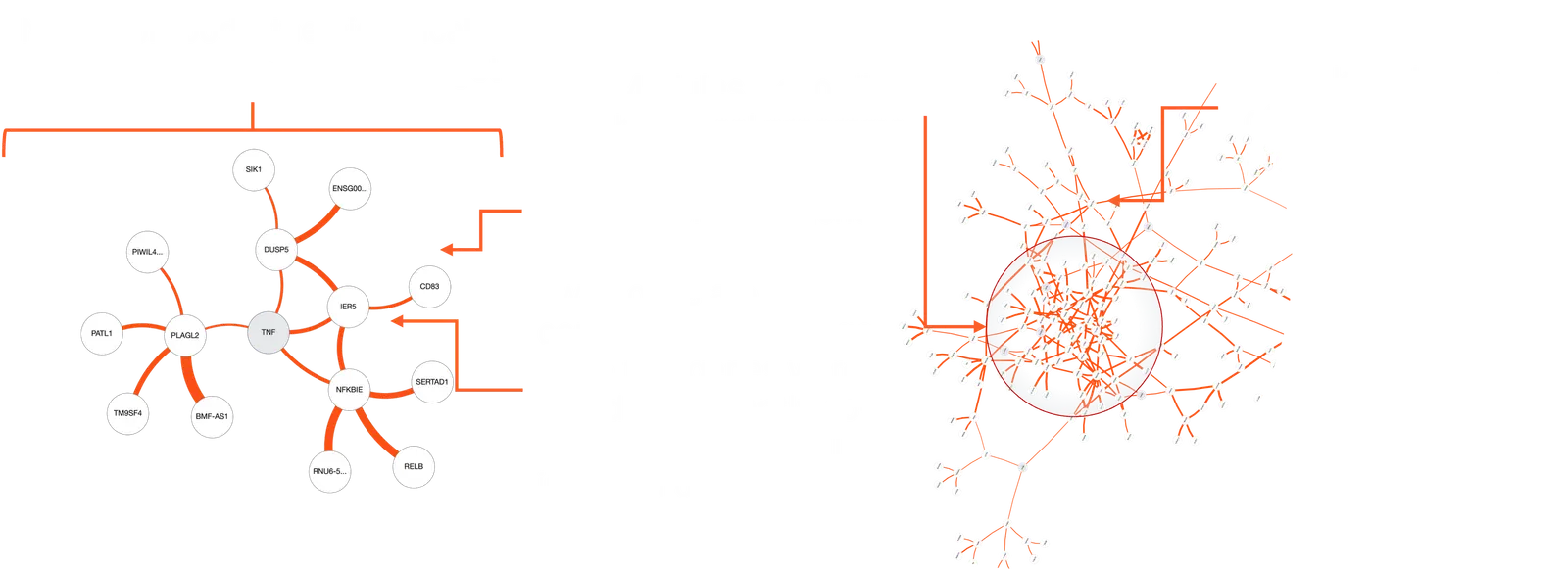
DINA calculates how consistently each pair of genes is co-expressed across the integrated datasets. A connection’s strength reflects how many datasets support it and how strong the correlation is, and only each gene’s strongest connections are kept, so the network reflects real biology rather than random noise.
The Network
The pattern is there, DINA finds it
The information isn’t in any single connection. It’s in the structure of the network. Each gene is a node, and two genes are connected when they are consistently co-expressed across the included datasets. Together, these connections form neighborhoods that show the biological context around a gene or target, modules of genes that work together as coordinated biological programs, and hubs, the key genes that hold those programs together.
- 8M+ transcriptomes
- 185M single cells
- 45+ generated disease networks

Founding research
Built on peer-reviewed science
- Peer-reviewed · Nature Communications, 2019A scientific precursor to DINA helped identify why African green monkeys avoid AIDS progression despite lifelong SIV infection. (opens in a new tab)
- Peer-reviewed · Genome Med, 2024Built cell-type-specific network models of inflammatory disease, combining expression changes, cell-to-cell signalling and drug-target proximity, to rank thousands of drugs. Drugs prioritised in a mouse model of arthritis were validated in vitro and in vivo. (opens in a new tab)