Mavatar

The biological intelligence behind your next research hypothesis

The earliest point in the journey: understanding the biology before you commit to a hypothesis. Explore disease networks built from thousands of public transcriptomes. Put your genes, gene lists or DEGs in biological context, with no coding.

What is Mavatar Discovery

Disease networks you can explore in your browser

Mavatar Discovery is a web-based platform (SaaS) for exploring disease biology at the level of gene networks. It brings together thousands of public transcriptomes in tissue- and disease-specific networks that show which genes are consistently co-expressed across independent studies.

  • Runs in your browser
  • No coding needed
  • Free account

Where researchers start

Start from the question you already have

Tutorials & webinars

Learn Discovery

All tutorials (opens in a new tab)

Webinar · Apr 2026

Alzheimer’s disease: from gene lists to biological mechanisms

With Prof. Tomas Deierborg, we show how network analysis turns GWAS hits into testable biology, using galectin-3 (LGALS3) and its links to TREM2 and APOE in microglial activation

Features

One foundation, multiple research questions

Every view in Mavatar Discovery starts from the same place: a gene network built with DINA, our Deep Integrated Network Analysis. Each network combines thousands of samples from many independent studies and keeps only the connections that hold up across them.

  1. Start from a single gene, a gene list, a file upload, a curated gene list or known drug targets. Choose the tissue or disease network, set how far the network reaches, and filter as you go.

  2. Functional annotation shows which datasets, diseases and cohorts support each connection, so you can check where a signal comes from and follow it back to the original studies.

  3. Compare how your network genes are expressed across diseases, healthy conditions, and biopsy sites.

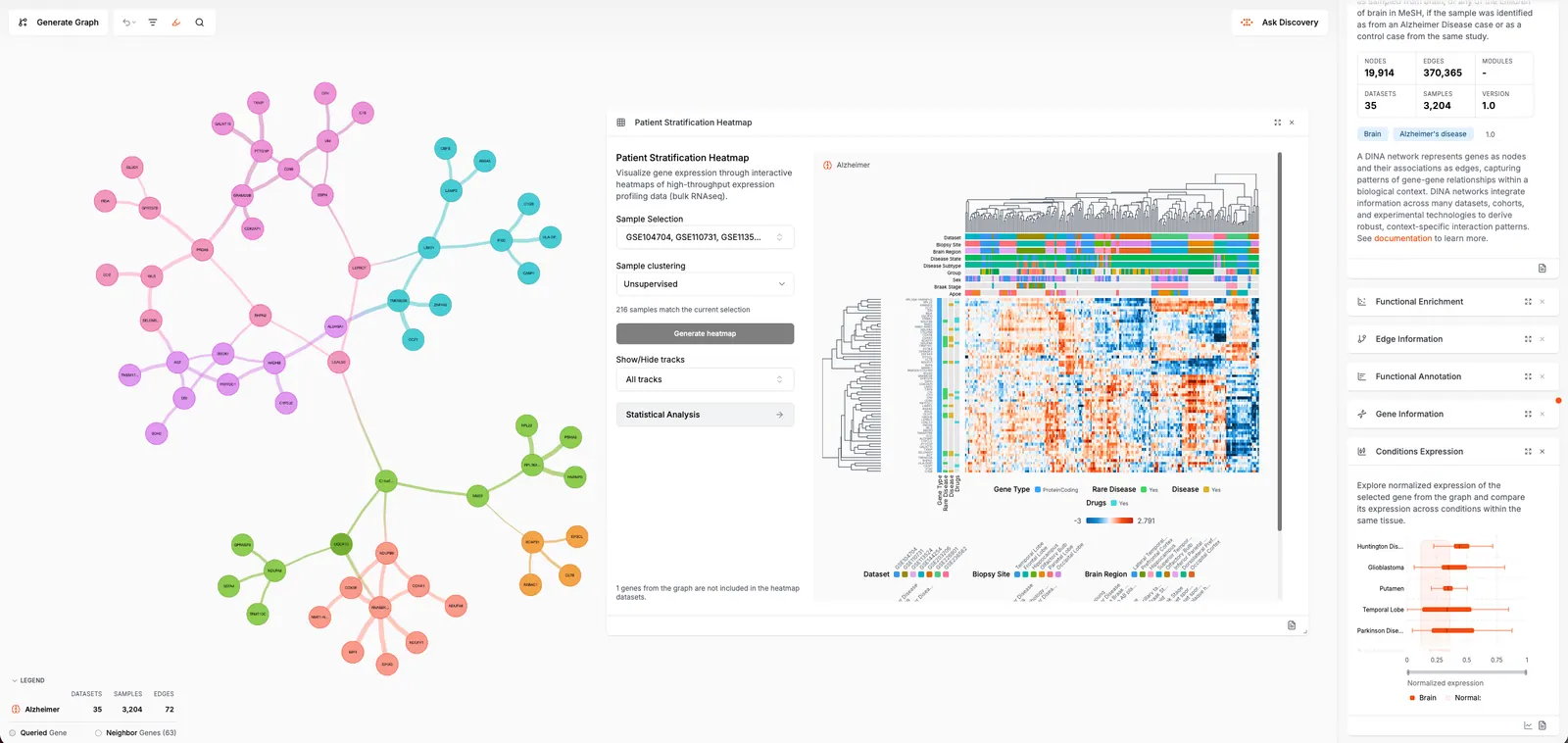
  4. The patient stratification heatmap clusters samples and genes to show how expression varies across patient cohorts. A built-in statistical test checks whether sample categories, such as disease or tissue, are significantly enriched in any cluster.

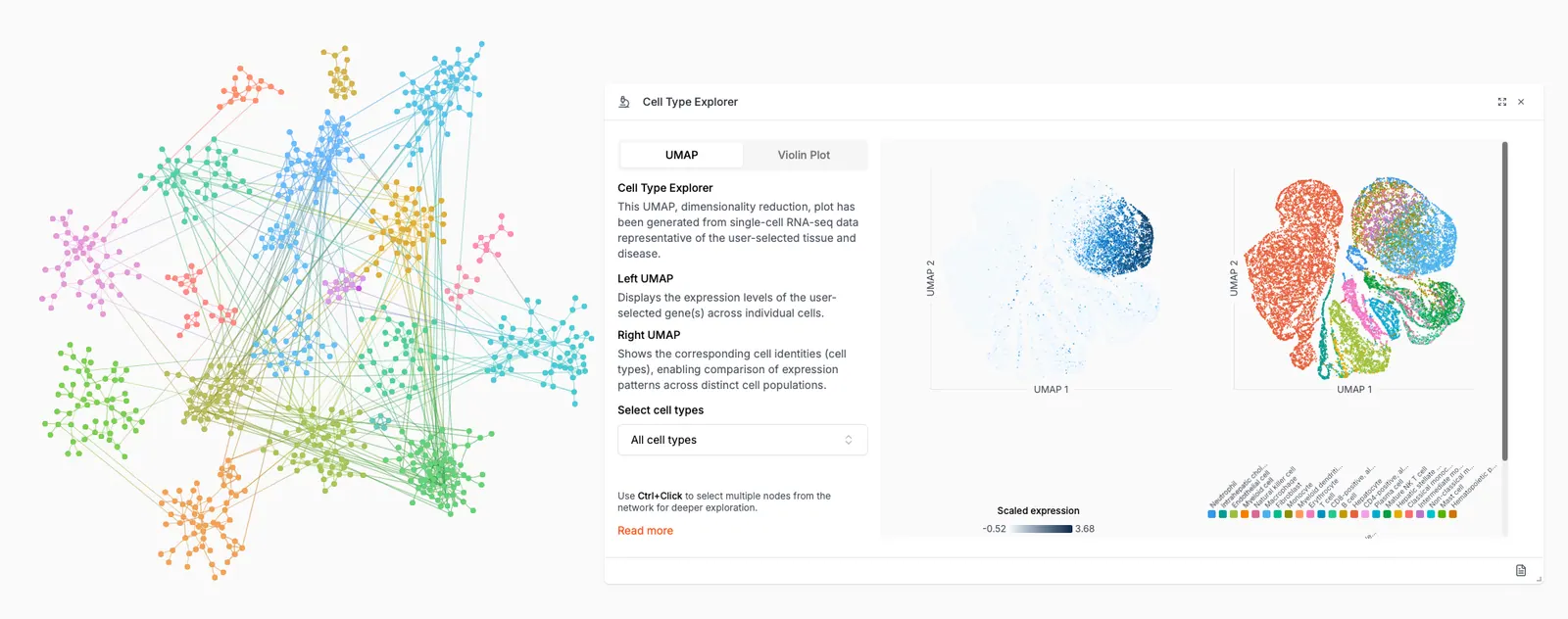
  5. The Cell Type Explorer shows where your genes are expressed across cell types in the tissue, as UMAPs and violin plots. Select genes in the network and see which cell populations express them.

  6. Run functional enrichment on the whole network or on a selected cluster. Test your genes against Gene Ontology terms, Mavatar curated gene lists and disease gene sets, and see which biological processes, programs and diseases are over-represented.

Example of an editable network visualisation in Mavatar Discovery.

Understanding Alzheimer’s disease requires looking beyond individual genes - and even beyond individual tissues - to the broader biological systems that drive neurodegeneration. Platforms that integrate diverse molecular datasets and reveal network-level relationships can help researchers generate new hypotheses and better understand the complex mechanisms.

Tomas Deierborg, Professor of Experimental Medical Science at Lund University

HOW IT WORKS

From molecular data to biological insight

Our integrated AI agent - Ask Discovery - provides workflow guidance, not autonomous scientific interpretation.

Why Discovery

Built from data, not from literature mining

Data-driven, not literature-based. Unlike literature-based network tools, connections come from measured data, so it can show relationships no one has published yet.

Context-specific and reproducible. A gene pair co-expressed in blood may not be connected in brain. Each network reflects one tissue, disease or cell type. A connection is kept only if it appears consistently across many independent studies.

Traceable. Every connection links back to the datasets and samples behind it.

Screenshot of Mavatar Discovery

Mavatar Discovery enabled us to develop a biologically plausible, testable hypothesis from gene expression data. Its network analyses allowed us to systematically explore convergence across different analytical settings and informed downstream functional annotation, statistical analyses, and the design of a prospective clinical study.

Zélia Lumack do Monte, MD, PhD candidate at NOVA Medical School

FAQ

Frequently Asked Questions

  • Mavatar Discovery is a web-based platform for exploring disease biology at the level of gene networks. It contains tissue- and disease-specific networks built from thousands of public transcriptomes, each showing which genes are consistently co-expressed across many independent studies. You can search a gene, upload a gene list or start from a pathway, and see how your genes connect in the tissue and disease you’re studying. There’s nothing to install and no code to write.

    • Academic and translational researchers studying disease mechanisms, interpreting gene lists or building hypotheses for grants and experiments.
    • Pharma and biotech teams who want to explore a target’s biology, check internal findings against independent public data or compare mechanisms across diseases.
    • CROs that want to give clients biological context without building their own data infrastructure.

    If you’d rather have our scientists answer a question for you, See Pharma Services.

  • Most analysis tools give you methods (differential expression, clustering, heatmaps) and leave you to collect, clean and integrate the data yourself. In Mavatar Discovery that work is already done; thousands of public samples have been curated, harmonized and integrated into ready-to-use networks before you log in.

    It’s also different from literature-based network tools. Our networks come from measured gene expression, not published knowledge, so they can show relationships no one has described yet. Each network is specific to a tissue or disease, because genes that work together in blood may not in brain. And every connection can be traced back to the datasets and samples behind it.

    You can also compare contexts. Studying a hematological cancer, for example, you can compare a leukemia network in bone marrow and blood to look for shared mechanisms.

  • Public transcriptomic data from sources such as Gene Expression Omnibus (GEO), ArrayExpress, The Cancer Genome Atlas (TCGA), CELLxGENE and the Single Cell Portal, covering bulk and single-cell RNA sequencing. Our R&D team curates the metadata for every dataset and sample, including tissue, biopsy site and disease, so data from different studies can be compared fairly. New data is added as it’s published.

  • The networks are built with DINA (Deep Integrated Network Analysis), our network framework, which is built on more than 20 years of research. For each tissue or disease, DINA combines many independent datasets and links two genes only when they are consistently co-expressed across them. Connections that appear in just one study are filtered out, so what remains is more likely to be real biology than noise.

    • Build a network around a gene, a gene list, a curated gene list or known drug targets, in the tissue or disease of your choice.
    • Compare two networks side by side, for example two tissues, disease vs healthy, or linear vs non-linear (AI) networks.
    • Trace each connection to its source: see which datasets, diseases and cohorts support it.
    • Find communities and hub genes to see how a large gene list breaks into biological programs.
    • See expression across conditions, comparing disease and healthy samples.
    • Explore patient subgroups with the patient stratification heatmap and its built-in statistical test.
    • Explore single-cell expression with the Cell Type Explorer (UMAPs and violin plots).
    • Run functional enrichment against Gene Ontology, Mavatar curated gene lists and disease gene sets.
    • Highlight drug targets using ChEMBL data.
    • Read gene and dataset descriptions next to the network, including the study design behind each dataset.

    See all features in the documentation.

  • Mavatar Discovery generates hypotheses and context. It doesn’t validate biomarkers, identify drug targets for you or replace lab experiments. It helps you decide which candidates and experiments are worth your time and gives your findings a stronger biological foundation.

  • Yes, you can upload gene lists, such as DEGs, screen hits or GWAS genes, using gene symbols or Ensembl IDs. You can add the direction of regulation (1 for up, -1 for down) and the genes will be colored in the network. Genes from other species, such as mouse, need to be converted to human orthologs first, for example with Ensembl BioMart.

  • Your searches are not stored, linked to your account, used for analytics or shared with third parties, and they’re never used to train models.

  • Network figures as PNG or SVG (vector graphics), with adjustable colors, layouts and preset themes for publication. Tables or gene lists can also be exported with community annotations.

  • Most networks are generated in seconds. Larger queries and heatmaps can take minutes, depending on the number of genes and samples.

  • Contact us. We can set up a project to survey the available data and build a network for your tissue or disease.

  • When you use our platform in your research, please cite us. Some examples on how to cite Mavatar Discovery are given below:

    The graph was generated based on the [tissue, context] (version 1.0) network using Mavatar Discovery v1.1.0 (2025 Mavatar, https://discovery.mavatar.com).

    The graph was generated based on the combined [1st tissue, context] (version 1.0) and [2nd tissue, context] (version 1.0) networks using Mavatar Discovery v1.1.0 (2025 Mavatar, https://discovery.mavatar.com).

    The analyses were done based on the [tissue, context] (version 1.0) network using Mavatar Discovery v1.1.0 (2025 Mavatar, https://discovery.mavatar.com).

  • Start with the Documentation & Learning Hub, which has step-by-step guides and video tutorials. Ask Discovery, our built-in assistant, can explain scientific concepts and how to use the platform. It can’t see your graphs or results. For anything else, contact us.

Start exploring today

Create a free account and build your first network in minutes. Your searches aren’t stored, linked to your account or used to train models.